






Welcome!
My name is Marin Vogelsang and I’m a postdoctoral researcher working with Prof. Pawan Sinha at the Department of Brain and Cognitive Sciences at MIT since April 2024. With a background in Computational Neuroscience, Computer Science, and Cognitive Science, my work is currently focussed on studying visual learning in humans and machines. I am primarily engaging in simulations with deep neural networks as computational model systems but am also fortunate to be involved in the study of children treated for congenital blindness late in life, through Project Prakash.
Research Interests
- Deep neural network
- Computational models
- Visual learning
- Human development
Education
- Dr. rer. nat in Cognitive Science, 2024, University of Osnabrück
- BSc. in Computer Science, 2023, EPFL, Lausanne
- MSc. in Neural Systems & Computation, 2019, UZH/ETH Zurich
- BSc. in Biological Sciences, 2017, The University of Tokyo
News
[2026/06]: Excited to attend the Lindau Nobel Laureate Meeting in Lindau, Germany!
[2026/05]: Excited to present at MODVIS and VSS in St. Pete Beach, USA, supported by a FoVea Travel and Networking Award!
[2026/05]: New paper on longitudinal changes in nystagmus following late treatment for congenital blindness in Investigative Ophthalmology & Visual Science ! [Paper]
[2026/05]: New paper on the role of early visual experience in cross-signal dependency detection in Developmental Science ! [Paper]
[2026/04]: 'Impact of early visual experience on later usage of color cues' received an Outstanding Paper Award from UJA, Japan! [Link]
[2025/11]: New paper on time-limited neuronal plasticity in early visual development in Developmental Science ! [Paper]
[2025/10]: New review on the temporal scaffolding of sensory organization in Annual Review of Psychology ! [Paper]
[2025/10]: Selected for the EECS Rising Star Workshop at MIT!
[2025/10]: Excited to present at the Timing Research Forum in Tokyo, Japan!
[2025/08]: Excited to present at CCN in Amsterdam, Netherlands, and ECVP in Mainz, Germany!
[2025/07]: Our research featured in MIT News: 'Babies' poor vision may help organize visual brain pathways'. [MIT News]
[2025/07]: New paper on the emergence of the parvo-magno distinction in Communications Biology ! [Paper]
[2024/05]: 'Impact of early visual experience on later usage of color cues' published in Science ! [Paper]
Featured Publications
Impact of early visual experience on later usage of color cues (Vogelsang et al., Science, 2024)
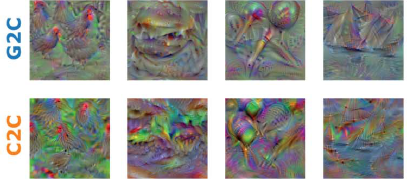
Human visual recognition is remarkably robust to changes in color information. Here, we provide a potential account of the roots of this resilience based on observations with congenitally blind children who gained sight late in life. Following their sight-restoring surgeries, the removal of color cues markedly reduced their recognition performance, whereas age-matched normally sighted children showed no such decrement. This finding may be explained by the greater-than-neonatal maturity of the late-sighted children’s color system at sight onset, inducing overly strong reliance on chromatic cues. Simulations with deep neural networks corroborate this hypothesis. These findings highlight the adaptive significance of typical development and provide guidelines for enhancing machine vision systems.
Potential role of developmental experience in the emergence of the parvo-magno distinction
(Vogelsang et al., Communications Biology, 2025)
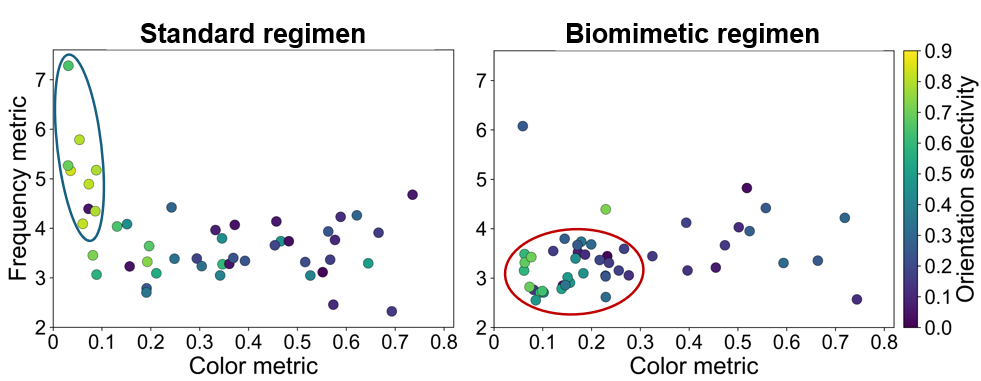
While the division of the early visual pathway into parvo- and magnocellular systems is well established, the factors underlying its emergence remain unclear. Here, we suggest that this division may partly arise from the temporal overlap in the maturation of spatial frequency and chromatic sensitivities as part of early visual development. Receptive field analyses of deep networks trained with developmentally inspired ‘biomimetic’ protocols provide support for this account. Such training also promotes more global shape processing, potentially driven by magnocellular-like units. These findings have implications for understanding visual pathway organization and for designing more human-like machine vision systems.
Prenatal auditory experience and its sequelae (Vogelsang et al., Developmental Science, 2022)
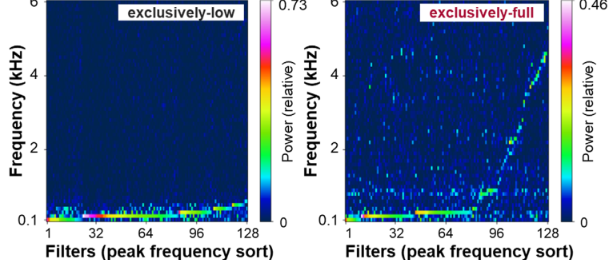
Towards the end of the second trimester of gestation, a human fetus is able to register environmental sounds. This in utero auditory experience is characterized by comprising strongly low-pass-filtered versions of sounds from the external world. In this paper, we present results of computational simulations supporting the view that exposure to initially degraded auditory inputs serves an adaptive purpose – it may induce the neural development of extended temporal integration, which is crucial for tasks such as emotion recognition. In addition, this finding can help explain some of the auditory impairments associated with preterm births, suggests guidelines for the design of auditory environments in neonatal care units, and points to enhanced training procedures for computational models.
Butterfly effects in perceptual development: A review of the ‘adaptive initial degradation’ hypothesis
(Vogelsang et al., Developmental Review, 2024)
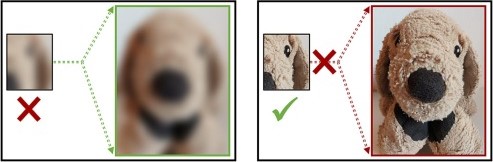
Human perceptual development evolves in a stereotyped fashion, with initially limited capabilities maturing over the months or years following the commencement of sensory experience into robust proficiencies. Here, we review recent findings from studies of children who experienced alterations of early development, as well as results from computational models, which provide compelling evidence that the limitations of early sensory experience may act as scaffolds, rather than hurdles, being causally responsible for the acquisition of later perceptual proficiencies. These results have implications for understanding typical developmental trajectories, help account for the perceptual deficits observed in atypically developed individuals, and inspire more robust training procedures for computational learning systems.
Publication list (* = equal contribution)
Ralekar, C.*, Vogelsang, M.*, Vogelsang, L.*, Kumar, A., Lall, N., Gupta, P., Diamond, S., Ganesh, S., & Sinha, P. (2026). Longitudinal changes in nystagmus following late treatment for congenital blindness. Investigative Ophthalmology & Visual Science. [Paper]
Gupta, P., Vogelsang, L., Vogelsang, M., Khemani, N., Jain, M., Lall, N., Verma, D., Ralekar, C., Ganesh, S., & Sinha, P. (2026). The role of early visual experience in cross-signal dependency detection. Developmental Science. [Paper]
Vogelsang, M., Vogelsang, L., & Sinha, P. (2025). Computationally probing the role of time-limited neuronal plasticity in early visual development. Developmental Science, 29(1), e70099. [Paper]
Sinha, P., Vogelsang, L., Vogelsang, M., Yonas, A., & Diamond, S. (2025). The temporal scaffolding of sensory organization. Annual Review of Psychology, 77. [Paper]
Vogelsang, M., Vogelsang, L., Pipa, G., Diamond, S., & Sinha, P. (2025). Potential role of developmental experience in the emergence of the parvo-magno distinction. Communications Biology, 8(1), 987. [Paper]
Vogelsang, L.*, Gupta, P.*, Vogelsang, M., Shah, P., Tiwari, K., Verma, D., Yadav, M., Raja, S., Ganesh, S., & Sinha, P. (2025). The status of vernier acuity following late sight onset. Developmental Science, 28(2), e13616. [Paper]
Gupta, P., Vogelsang, M., Vogelsang, L., Shah, P., Gilad-Gutnick, S., & Sinha, P. (2024). The influence of semantics on long-term visual memory capacity in children and adults. British Journal of Developmental Psychology, 42(3), 392-408. [Paper]
Vogelsang, M.*, Vogelsang, L.*, Gupta, P.*, Gandhi, T., Shah, P., Swami, P., Gilad-Gutnick, S., Ben-Ami, S., Diamond, S., Ganesh, S., & Sinha, P. (2024). Impact of early visual experience on later usage of color cues. Science, 384(6698), 907-912. [Paper]
Vogelsang, L.*, Vogelsang, M.*, Pipa, G., Diamond, S., & Sinha, P. (2024). Butterfly effects in perceptual development: A review of the 'adaptive initial degradation' hypothesis. Developmental Review, 71, 101117. [Paper]
Jarudi, I., Braun, A., Vogelsang, M., Vogelsang, L., Gilad-Gutnick, S., Boix, X., Dixon, W., & Sinha, P. (2023). Recognizing distant faces. Vision Research, 205, 108184.[Paper]
Bi, S., Chawariya, A., Ganesh, S., Gupta, P., Huang, Y., Jazayeri, K., Kumar, R., Ralekar, C., Singh, C., Tiwary, A., Vogelsang, L., Vogelsang, M., Yadav, M., & Sinha, P. (2023). Scholastic status of congenitally blind children following sight surgery. International Journal of Special Education, 37(2), 160.[Paper]
Vogelsang, M.*, Vogelsang, L.*, Diamond, S., & Sinha, P. (2022). Prenatal auditory experience and its sequelae. Developmental Science, 26(1), e13278. [Paper]
Gupta, P., Shah, P., Gilad-Gutnick, S., Vogelsang, M., Vogelsang, L., Tiwari, K., Gandhi, T., Ganesh, S., & Sinha, P. (2022). Development of visual memory capacity following early-onset and extended blindness. Psychological Science, 33(6), 847-858.[Paper]